
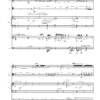
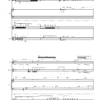

Théorème
Patrick MarclandInformations sur l’œuvre :
Titre : Théorème
Compositeur : Patrick Marcland
Effectif : clarinette en Si♭, trombone, piano, violon et violoncelle
Genre : musique de chambre pour cinq instruments
D’après : l’œuvre éponyme de Pier Paolo Pasolini
Date de composition : 2022
Durée : 11’20
Nombre de mouvements : 5
Création :
Date de création : 20 janvier 2023
Lieu de création : Conservatoire à rayonnement régional de Nice, France
Ensemble créateur : Ensemble Inicia!
Interprètes : François Draux, clarinette ; Benny Sluchin, trombone ; Stefanos Thomopoulos, piano ; Sona Khochafian, violon ; Pierre Strauch, violoncelle
Direction : Fabrice Pierre
Informations éditoriales :
Nombre de pages : 40
Éditeur : Lacroch’
Cotage : —
ISMN : —
Date de publication : septembre 2026
Description
Théorème
d’après Pier Paolo Pasolini
Français :
« Avec la musique, la géométrie demeure la plus énigmatique découverte de l’homme » (Maria Maïlat)
Le film de Pier Paolo Pasolini, comme son roman du même nom, s’inscrit dans la genèse du projet de cette pièce. Il n’était évidemment pas question de tenter une illustration musicale des situations ou personnages du film (ou du roman qui en est à l’origine); ni de sa signification symbolique voire mystique. C’est sa structure formelle particulière qui m’a intéressé. Il ne s’agit, ni dans le livre ni dans le film, d’une quelconque analyse psychologique, ni d’une peinture sociale, même si l’appartenance bourgeoise des protagonistes les caractérise. Ceux-ci sont autant d’unités formelles qui se focalisent à un moment sur la figure centrale d’une élément exogène qui, à la manière d’un jeu de quille, bouleversera l’ordre dans lequel ils se meuvent et du coup leur relation au monde.
Le Théorème de Pasolini nest pas, comme il le dit lui-même, un récit réaliste mais plutôt une parabole, un relevé quasi scientifique, plaçant les personnages comme des pions sur un échiquier, chacun doté d’une fonction dans une conception formelle. On peut y voir un pentagone dont les sommets equidistants (cf les cinq membres de la famille) vont se désorganiser par l’irruption et l’attraction d’un élément étranger à la structure.
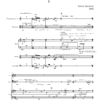
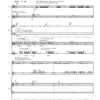
La pièce tourne donc autour du chiffre 5 et des caractéristiques mathématiques propres au pentagone régulier : il y a 5 séquences de durée égale, très caractérisées quant aux rythmes, aux proportions et à l’écriture en général. Le même chiffre 5 (et sa fragmentation en 2 et 3) se retrouve à tous les niveaux du discours : le nombre d’instruments, les rythmes, les densités harmoniques et mélodiques, etc…
Evidemment, rien n’est à démontrer ici. Le théorème en question (du grec theorêma, « objet digne détude ») s’entend comme système déductif où un énoncé (musical en l’occurrence) engendre des conséquences logiques. PM (décembre 2022)
La première audition a été donnée au Conservatoire à Rayonnement Régional de Nice le 20 janvizer 2023 par l’Ensemble Inicia!
Interprètes : François Draux, clarinette, Benny Sluchin, trombone, Stefanos Thomopoulos, piano, Sona Khochafian, violon, Pierre Strauch, violoncelle, placés sous la direction de Fabrice Pierre.
Anglais :
« With music, geometry still the most enigmatic human discovery » (Maria Maïlat)
Pier Paolo Pasolini’s film, like his novel of the same title, is part of the genesis of the project for this piece. There was obviously no question of aempting a musical illustration of the situations or characters of the film (or of the novel which is at its origin); nor of its symbolic or even mystical significance. It is its particular formal structure that interests me.
There is neither in the book nor in the film, any psychological analysis, nor a social painting, even if the bourgeois belonging of the protagonists characterizes them. These are above all formal units which focus at one point on the central figure of an exogenous element which, like a bowling game, will upset the order in which they move and thus their relation to the world. Pasolini’s Theorem is not, as he says himself, a realistic narrative but rather a parabola, an almost scientific statement, placing the characters like pieces on a chessboard, each endowed with a function in a formal design.
We can see a pentagon whose equidistant vertices (see the five members of the family) will be disorganized by the irruption and araction of an element foreign to the structure. The piece therefore revolves around the number 5 and the mathematical characteristics specific to the regular pentagon :: there are 5 sequences of equal duration, very characteristic in terms of rhythms, proportions and writing in general. The same number 5 (and its fragmentation into 2 and 3) is found at all levels of the musical discourse : the number of instruments, the rhythms, the harmonic and melodic densities, etc…
Obviously, nothing is to be demonstrated here. The theorem in question (from the Greek theorêma, « object worthy of study ») is understood as a deductive system where a statement (musical in this case) generates logical consequences. PM (December 2022)
The first performance has been given at the Regional Conservatory in Nice on January 20, 2023, by Ensemble Inicia!
Musicians were François Draux, clarinet, Benny Sluchin, trombone, Stefanos Thomopoulos, piano, Sona Khochafian, violin, Pierre Strauch, cello, direction by Fabrice Pierre.
Informations complémentaires
| Poids | 1 kg |
|---|---|
| Dimensions | ND |
| Format | Papier, Digital (PDF), Matériel |
À décrouvrir également :
-
 Alice Barat
Floyd
Plage de prix : 25,00 € à 34,00 € Choix des options Ce produit a plusieurs variations. Les options peuvent être choisies sur la page du produit -
 Alice Barat
Tout est incertain, même l’azur
Lire la suite -
 Didier Rotella
Baiser volé
Plage de prix : 34,00 € à 42,00 € Choix des options Ce produit a plusieurs variations. Les options peuvent être choisies sur la page du produit -
 Sofia Avramidou
Dimorphos Delta / Folk Song VII
Plage de prix : 27,00 € à 38,00 € Choix des options Ce produit a plusieurs variations. Les options peuvent être choisies sur la page du produit